CEBU CITY — Cebu governor, Pamela Baricuatro has signed Executive Order (EO) No. 55 on October 24, imposing stricter border controls for all live hogs, pork, and pork products entering the province in a bid to protect Cebu’s ₱20-billion hog industry and secure the island’s food supply.
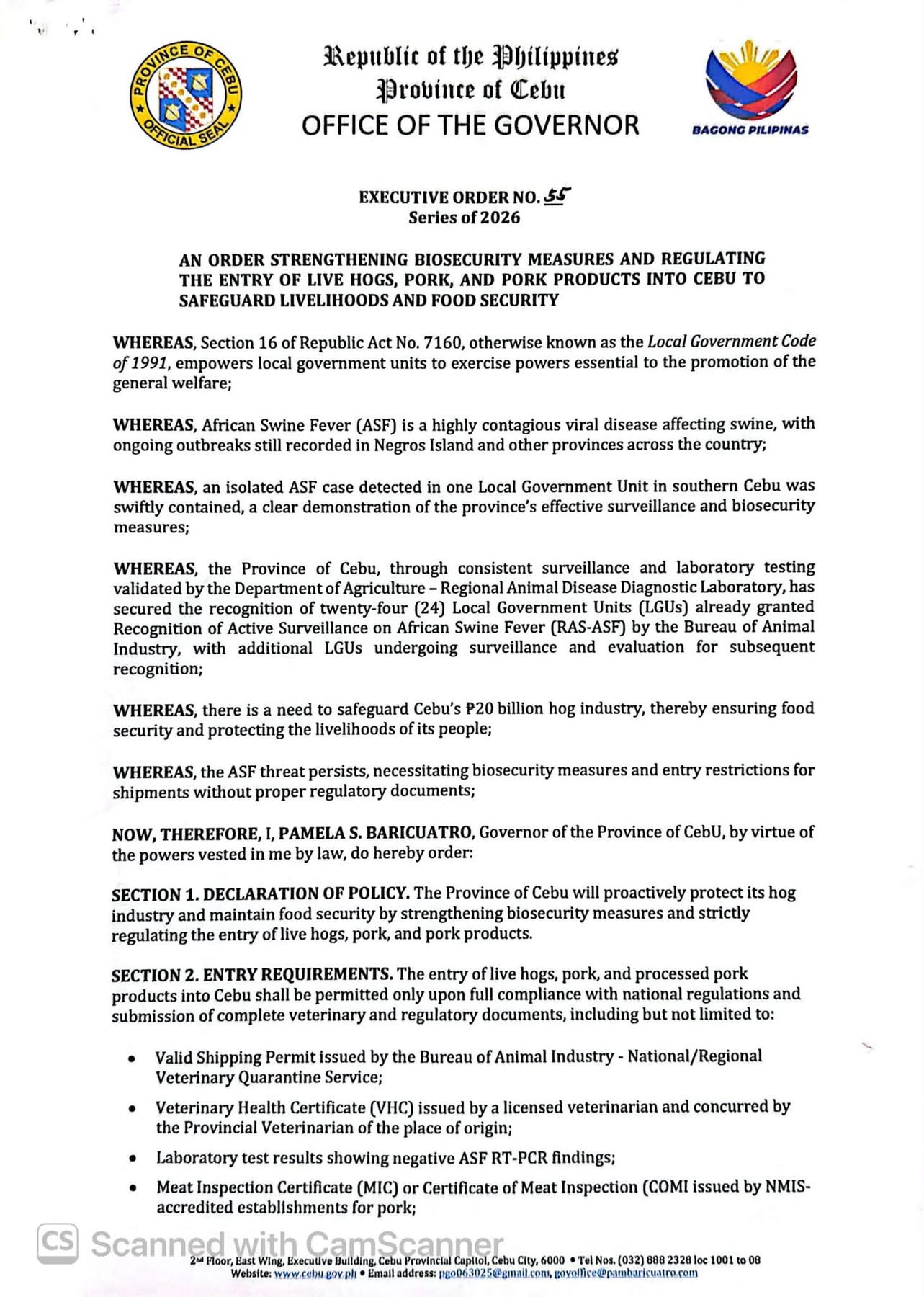
The EO mandates that all shipments must now pass through designated ports with veterinary quarantine officers and carry complete documents: valid shipping permits, veterinary health certificates, and laboratory results showing negative ASF RT-PCR tests.
“One case is already one case too many,” Baricuatro said. The province earlier contained an isolated ASF case in southern Cebu, but outbreaks continue to be reported in Negros Island and other parts of the country.
Under the new rules, live hogs will only be allowed into Cebu if they are headed directly to National Meat Inspection Service-accredited slaughterhouses for lechon preparation. They cannot be brought in for breeding or resale.
Shipments with incomplete papers, no declared accredited slaughterhouse, or those that bypass designated quarantine seaports face confiscation, forfeiture, or will be sent back to their place of origin.
The EO also deputizes LGUs, port authorities, the Philippine Coast Guard, and the Philippine National Police to strictly enforce inspections at all entry points and checkpoints.
Local governments were further ordered to strengthen surveillance, laboratory testing, public information drives, and farm-level biosecurity. They must also pass or update ordinances to align with Provincial Ordinance No. 2025-12.
The Department of Agriculture’s Bureau of Animal Industry (DA-BAI) has already recognized 24 Cebu LGUs for “Active Surveillance on ASF,” a sign that the province’s monitoring system is working.
The order took effect immediately and will remain in force until revoked or amended.
For Cebu’s thousands of hog raisers, lechon makers, and market vendors, the move is meant to do one thing: keep ASF out and keep pork on the table.
“The goal is simple — protect livelihoods and protect food security,” the EO stated. (Photo: Capitol PIO)